The Great Turf War
The century-old conflict that shaped every game
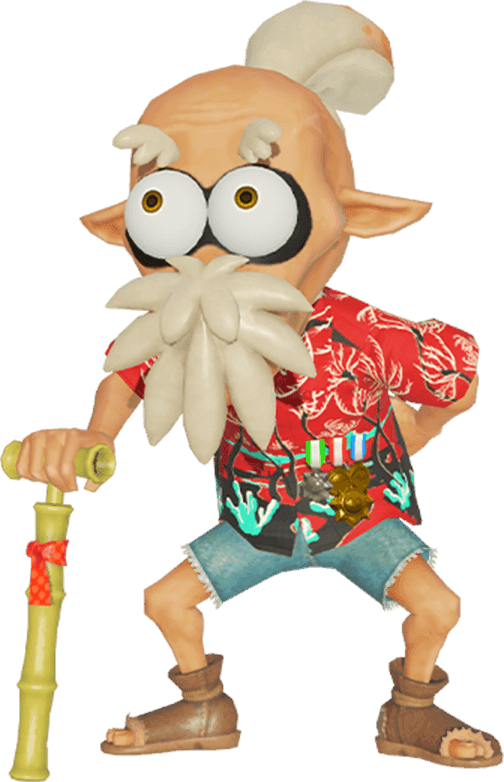
Before Turf War was a sport, it was a war. The Great Turf War is the founding trauma of the Splatoon world, referenced by nearly every major character and documented across dozens of Sunken Scrolls. It took place roughly one hundred years before the events of Splatoon 1, and its outcome is the reason Inkopolis exists at all.
What they were fighting over
Land. With most of the planet underwater, the surviving dry ground was precious, and two rising species both wanted it. The Inklings, descended from squid, and the Octarians, descended from octopus, had lived alongside each other for generations. As the population grew and the land did not, that peace broke down.
Sunken Scrolls from the first game frame the Octarians as the aggressors, at least from the Inkling perspective. Propaganda posters and battlefield sketches show Octarian forces with technologically superior weaponry, most famously the Great Octoweapons: enormous mechanical constructs that could flatten Inkling positions. On paper, the Octarians should have won.
The Squidbeak Splatoon
The Inkling side of the war is remembered largely through the Squidbeak Splatoon, a small elite unit that included a young soldier named Craig Cuttlefish. He would later become Cap'n Cuttlefish, the wizened old squid who recruits Agent 3 in Octo Valley. Scrolls show the unit as a scrappy band armed with primitive ink weapons against the Octarian war machine. Cuttlefish's stories, told to every agent he meets, make it clear that the Squidbeak Splatoon considered themselves the underdogs.
One of the more poignant threads in the series is the suggestion that Cuttlefish and the Octarian commander DJ Octavio knew each other before the shooting started. Their exchanges in later games bristle with the familiarity of old rivals rather than strangers, and Splatoon 3 puts them side by side again as reluctant allies. Fans have long read the two of them as former comrades whose friendship was one of the war's casualties.
How it ended
The Octarians lost, but not because they were outfought. According to a Sunken Scroll, their Great Octoweapons shut down in the middle of the decisive battle because a plug on their power supply came loose. The Inklings surged forward, the Octarian lines broke, and the war was over.
It is a wonderfully absurd detail, and it is presented with a completely straight face. The most consequential moment in cephalopod history was a tripped cord. That single accident is examined in its own article, because it explains the Octarians' obsession with energy and the theft of the Great Zapfish that kicks off the first two games.
Legend says the Octarian machines fell silent all at once. Nobody on the surface knew why until the scrolls were found.
The peace, and its price
The Inklings claimed the surface. The Octarians retreated into the deep, building sprawling underground domes beneath Octo Valley and Octo Canyon, lit by artificial skies and powered by whatever energy they could steal or scavenge. Over a century, those domes decayed. The Octarians never forgot who had pushed them into the dark, and their propaganda kept the war alive for generations of Octolings who had never seen the sun.
On the surface, the opposite happened. The Inklings turned the war into a game. Turf War became a sport with rules, referees, and pop stars, and the memory of the real conflict faded into something children read about on scrolls. By the time the first game begins, most Inklings have no idea the Octarians still exist. Cap'n Cuttlefish, standing watch over Octo Valley with his radio and his cane, is nearly the only one who remembers.
Every villain arc in the series is a sequel to the Great Turf War. DJ Octavio's raids in Splatoon 1 and 2 are attempts to reverse its result. The Octo Expansion is about Octolings who no longer want to fight it. Splatoon 3 opens with Octarians who have deserted en masse, and its final act reframes the whole conflict as a squabble between siblings when a far older enemy shows up. Even the idols carry it: Marina defected from the Octarian army, and Shiver's ambiguous heritage keeps the old lines blurry.
The Great Turf War was not a glorious victory. It was a mistake that both sides have spent a hundred years learning to undo.