Sunken Scrolls Explained
The hidden documents that turned a shooter into a mythology
The Sunken Scrolls are the reason Splatoon has lore at all. Hidden in every level of the first game's Octo Valley and the second game's Octo Canyon, and reimagined as the Alterna Logs in Splatoon 3, these collectible documents are the only place the series ever explains itself. Nothing in the multiplayer or the shops says a word about drowned humans or lost wars. The scrolls do, and only if you go looking.
How they work
In practice, a Sunken Scroll is a treasure chest tucked somewhere off the main path of a story level: on a ledge you have to Squid Jump to reach, behind a wall of enemy ink, or inside a crate you would never think to break. Grab it and a document is added to your collection in the hub. Each game hides a few dozen, plus one for each boss.
The documents themselves are wildly varied. Some are newspaper clippings. Some are illustrated charts. Some are photographs, sketches, or scraps of Octarian propaganda. Several are deliberately ambiguous, with a short caption that raises more questions than it answers. The presentation is a big part of the charm: the scrolls are presented as odd artifacts that a curious kid might find, and the captions have a dry, amused tone, as though the archivist cannot quite believe what they are looking at either.
The big revelations
Over three games, the scrolls and logs have delivered nearly every major piece of world history.
The flood. A human skeleton and a note about sea levels rising establish that humanity drowned roughly twelve thousand years ago.
Evolution. A chart traces the development of squid into Inklings.
The Great Turf War. Multiple scrolls document the century-old war between Inklings and Octarians, including the infamous loose plug that shut down the Octarian Great Octoweapons.
Cuttlefish and Octavio. Scrolls show a young Craig Cuttlefish with the Squidbeak Splatoon and imply the depth of his rivalry with DJ Octavio.
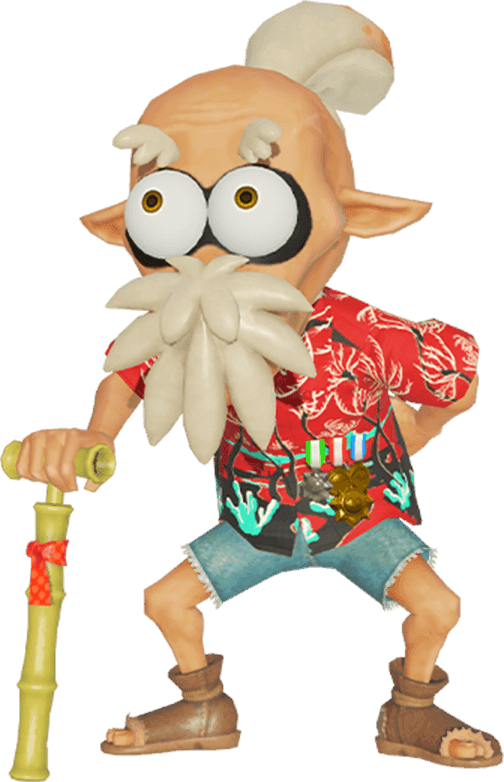
Judd. A scroll reveals that the Turf War referee is a cat placed in a preservation capsule by his human owner, thawed out after millennia.
The Squid Sisters. Splatoon 2 scrolls fill in Callie and Marie's family history and their connection to Cap'n Cuttlefish, their grandfather.
The Salmonids. Splatoon 2's scrolls include field notes on Salmonid culture, life cycle, and the fearsome Boss Salmonids.
Alterna. Splatoon 3's logs, found in the same way, describe the underground human refuge, its liquid crystal sky, and the bear who was sent into space.
A frayed piece of paper. A caption that shrugs. Somewhere in that shrug, a whole world.
The art of the unreliable archive
What makes the scrolls so effective is that they never lecture. A scroll will show a picture and offer a one-line note that could be read two or three ways. The evolution chart, for instance, could be a scientific document or a museum poster. The propaganda posters are obviously biased. The photographs are grainy. Fans are constantly reminded that these are fragments filtered through a cephalopod archivist who may be guessing.
This is a deliberate design choice. Splatoon's writers have said in interviews that they wanted the world to feel like it had depth without ever stopping the game to explain it. The scrolls let players who care dig in, while players who just want to splat can ignore them entirely. The result is a fanbase that argues about timeline details with the intensity of historians, over a game about paint.
Alterna Logs: the scrolls grow up
Splatoon 3 replaced the scrolls with Alterna Logs, and the shift in format matters. Where the scrolls were scattered curiosities, the logs are a single continuous narrative written by the humans of Alterna, unlocking in order as you clear the crater's sites. They read like a diary rather than a museum, and they build to a genuine emotional climax. It is the first time the series has let humans speak in their own voice at length, and it recontextualizes everything the scrolls had hinted at.
Side Order does not add a scroll collection in the same way, but Marina's notes and Acht's dialogue play a similar role, and the Memverse's Order Sector is itself a kind of archive of what might have been.
If you are new to the lore, the best order is chronological by game: Splatoon 1's scrolls for the flood and the war, Splatoon 2's for the Squid Sisters and Salmonids, the Octo Expansion's mem cakes and dialogue for Tartar and the Octolings, and the Alterna Logs for the human epilogue. Read in that order, they form one of the most coherent hidden histories in Nintendo's catalog, all told by someone who found it in a box and could not quite believe it.