The Drowning of the Old World
How rising seas ended the age of humanity
Every Splatoon story begins in the same quiet place: a world that used to belong to someone else. The Sunken Scrolls, the Alterna Logs, and Commander Tartar's own bitter monologues all agree on the broad strokes. Around twelve thousand years before the events of the first game, sea levels rose catastrophically, and the land-dwelling species that had built cities, roads, and rockets vanished beneath the water. Those species were, of course, us.
The games never say the word "human" in a menu or a mission title, but they do not need to. Skeletons in Splatoon 1's Sunken Scrolls are unmistakably human, and the Octo Expansion ends with a battle on top of a giant human statue. The past is always hiding in plain sight.
What the scrolls actually say
The most famous piece of evidence is a Sunken Scroll from the first game that shows a fossilized human skeleton next to a note that the "ancient creature" walked on two legs and died out when the seas rose. Another scroll depicts a diagram of squid evolving over the following millennia into the Inklings we know. Together they establish the rough timetable that every later game builds on: flood first, then a very long silence, then cephalopods.
The Octo Expansion sharpened that timeline. Commander Tartar, the artificial intelligence at the heart of Kamabo Co., states that it was created twelve thousand years ago by a human professor. Tartar's mission was to pass on humanity's accumulated knowledge to whichever species rose next. The flood, in other words, was not a surprise to everyone. At least one person saw it coming and tried to leave something behind.
The Alterna Logs in Splatoon 3 went further still, describing how a group of survivors retreated underground and how their attempt to outlive the flood went wrong. That story deserves its own article, but it confirms the essential fact: humans did not simply drown all at once. Some of them lingered, and the world Inklings inherit is littered with their unfinished projects.
Why the flood matters for ink
It is easy to treat the drowned world as flavor, but it is load-bearing lore. The Inklings and Octarians evolved specifically because so much of the planet became ocean. Their entire civilization is built on the scraps of land that remain, which is why the Great Turf War was fought over territory in the first place and why the Octarians ended up crammed into underground domes.
It also explains the strange, half-familiar texture of Inkopolis. Mannequins in shop windows, the Inkopolis Tower, the shape of the streets, the salaryman fish commuting on trains: the sea creatures are living in and around the wreckage of something older. Many of the game's stages are ruined human structures, from the shipping yard at Port Mackerel to the sunken town of Camp Triggerfish. The Deepsea Metro is quite literally a subway.
The seas rose. The old world sank. What grew afterward was small, strange, and full of ink.
Survivors, in a manner of speaking
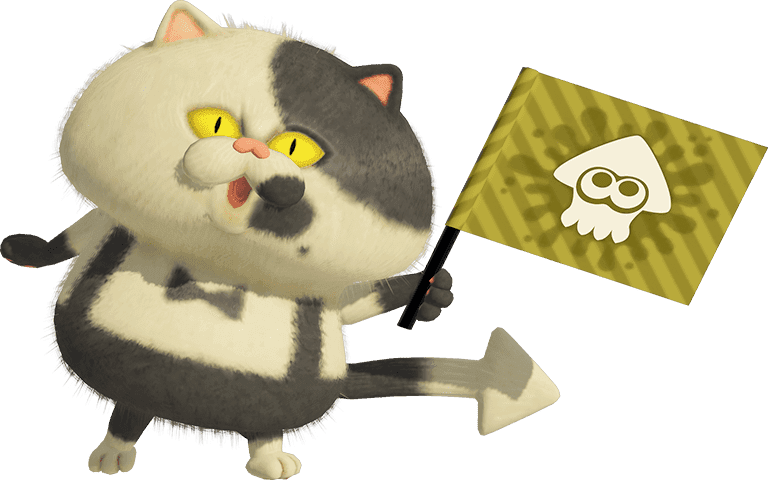
A handful of "survivors" still walk around, if you know where to look. Judd the cat was sealed in a capsule by his human owner before the flood and revived millennia later, which is why a mammal referees Turf Wars in a city of cephalopods. Commander Tartar survived as code. And Mr. Grizz, as Splatoon 3 revealed, is a bear launched into space by the humans of Alterna as a test subject. He returned to a planet where he was the last mammal left, and his grief curdled into the plan behind the Fuzzy Ooze.
Each of these leftovers carries a different lesson about the people who made them. Judd's owner loved his cat enough to try to save it. The professor who built Tartar wanted his species' knowledge to outlive him. The scientists of Alterna dreamed of the sky. None of them got a happy ending, but each of them left a mark on the world that came after.
The tone of the loss
What makes the Drowning so effective as a piece of worldbuilding is how gently the games handle it. There is no cutscene of cities collapsing, no grim exposition. The Sunken Scrolls are presented as curiosities for kids, and the squids who find them treat them with cheerful indifference. It is left to the player to feel the weight of what they are looking at.
That distance is the point. The Inklings are not haunted by humanity's fall because, to them, it is ancient history, as remote as the dinosaurs are to us. Only characters like Tartar and Mr. Grizz, who remember the old world, feel the loss keenly, and both of them turn that grief into something monstrous. The sea creatures who inherited the earth did not ask for it. They just got on with the business of living, and eventually, of splatting each other with paint for fun.